Pattern Recognition Trained on Clinical Truth.
AI that interprets what practitioners have read for millennia. Dual-encoder architecture fusing tongue imaging and pulse waveform analysis into organ-function trend indices, validated against expert TCM clinicians.
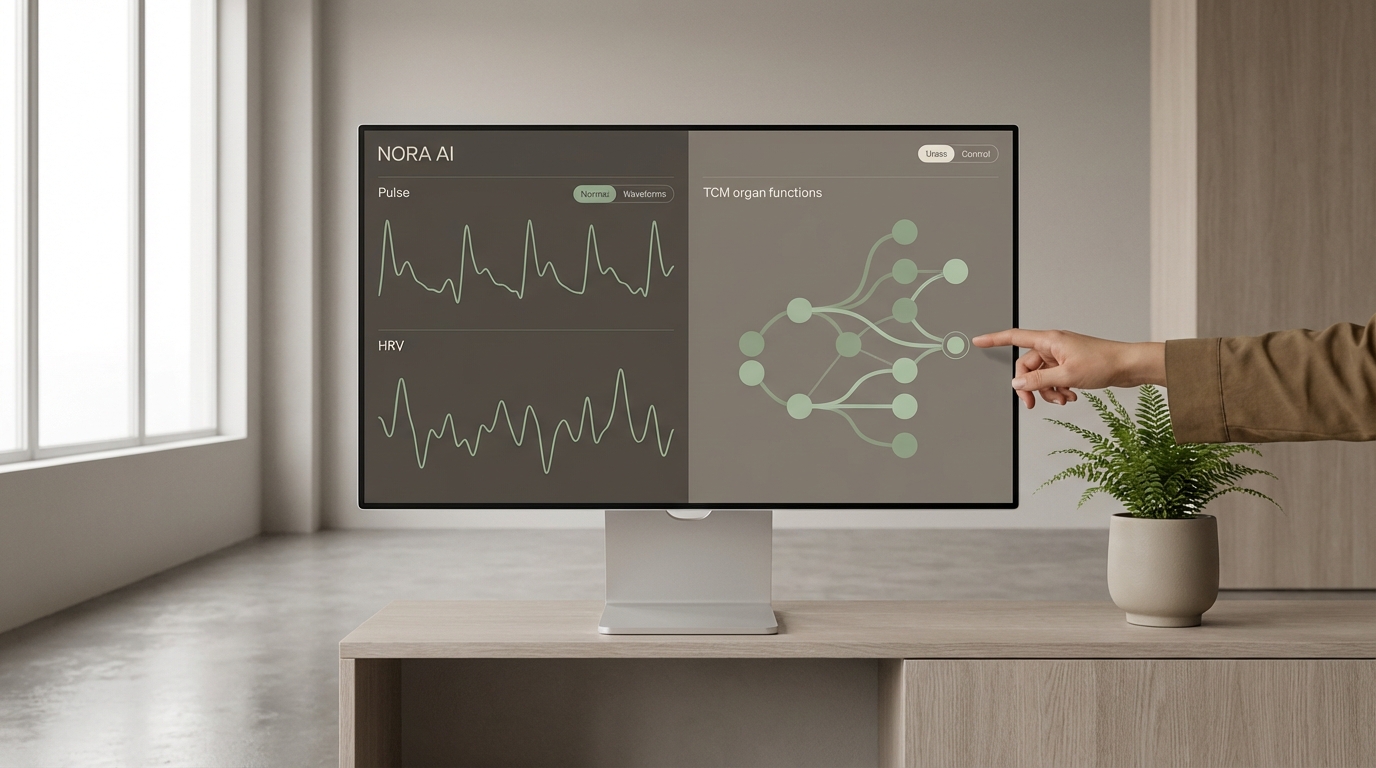
Two Encoders. One Clinical Intelligence.
NORA AI is not a chatbot layered on top of a quiz. It is a dual-encoder system purpose-built for clinical pattern recognition, fusing visual tongue analysis with temporal pulse waveform interpretation through adaptive attention fusion.
Vision Transformer (ViT)
Tongue image analysis trained on approximately 100,000 clinical tongue photographs. Identifies color, coating, shape, and sublingual vein patterns that TCM practitioners assess manually.
1D-CNN / LSTM Encoder
Pulse waveform interpretation drawing from 220,000+ synchronized pulse records. Captures temporal dynamics, amplitude ratios, and waveform morphology across radial artery positions.
Adaptive Attention Fusion
Cross-modal attention dynamically weights tongue and pulse signals per individual. The model learns which modality carries more diagnostic relevance for each organ system, case by case.
Sub-5-Second Inference
Complete organ-function trend indices delivered in under 5 seconds. Fast enough for clinical workflow integration without disrupting practitioner cadence.
Tongue images in training corpus
Synchronized pulse records
Inference time per assessment
Expert concordance rate
0% Concordance with Expert Practitioners.
In a clinical pilot of 200 cases, NORA AI achieved 92% concordance with expert TCM practitioner diagnosis. Not 92% accuracy on a curated test set. 92% agreement with human experts evaluating real patients.
This is not a chatbot giving wellness advice. This is clinical-grade pattern recognition validated against practitioners with decades of training. The AI reads the same signals they do, and arrives at the same conclusions.

What concordance means: NORA AI's organ-function trend indices were compared against independent assessments by licensed TCM practitioners. A 92% match rate indicates the AI is capturing the same clinical patterns that require years of hands-on training to recognize.
AI Generates Trend Indices
NORA AI processes tongue and pulse data to produce organ-function trend indices. These are directional signals, not medical diagnoses.
Practitioners Review Flagged Cases
When confidence scores fall below threshold or anomalies are detected, licensed clinicians review the assessment. Human judgment stays in the loop.
Continuous Feedback Improves the Model
Practitioner corrections flow back into the training pipeline. Every review makes NORA AI more accurate. The safety shield is also the improvement engine.
Practitioner-in-the-Loop. By Design.
NORA AI does not replace practitioners. It augments them. Every flagged case is reviewed by a licensed clinician, creating a safety shield that simultaneously improves model accuracy over time.
This is general wellness, non-diagnostic. NORA AI produces trend indices that inform protocol selection. It does not produce medical diagnoses, and it does not prescribe treatment.
Positioned at the Intersection of Trust and Timing.
Consumer trust in AI-powered health recommendations has crossed a critical threshold. The personalized nutrition market is accelerating. NORA AI sits at the center of both trends.
of Americans trust AI-powered supplement recommendations
Consumer health survey, 2024
AI in personalized nutrition market (2025)
Industry market analysis
Projected market size by 2034
Industry market analysis
CAGR through 2034
Industry market analysis
AI in Personalized Nutrition: $4.89B to $21.54B
The market for AI-driven personalized nutrition is projected to grow from $4.89 billion in 2025 to $21.54 billion by 2034, a 17.9% CAGR. NORA AI is not entering an unproven category. It is entering a category with strong tailwinds, armed with clinical validation that most competitors lack entirely.
IRB Replication Study. Planned Q2 2026.
The company is investing in clinical validation because the data supports it. The N=200 pilot demonstrated 92% concordance. The IRB replication study will expand the dataset, introduce independent oversight, and produce publishable results.
Expanded Dataset
Larger patient cohort with broader demographic representation. More data points, stronger statistical power.
Independent Oversight
IRB-approved protocol with independent review board supervision. Third-party validation of methodology and results.
Publishable Results
Study designed to produce peer-reviewable findings. Clinical credibility that opens doors with practitioners, partners, and regulators.